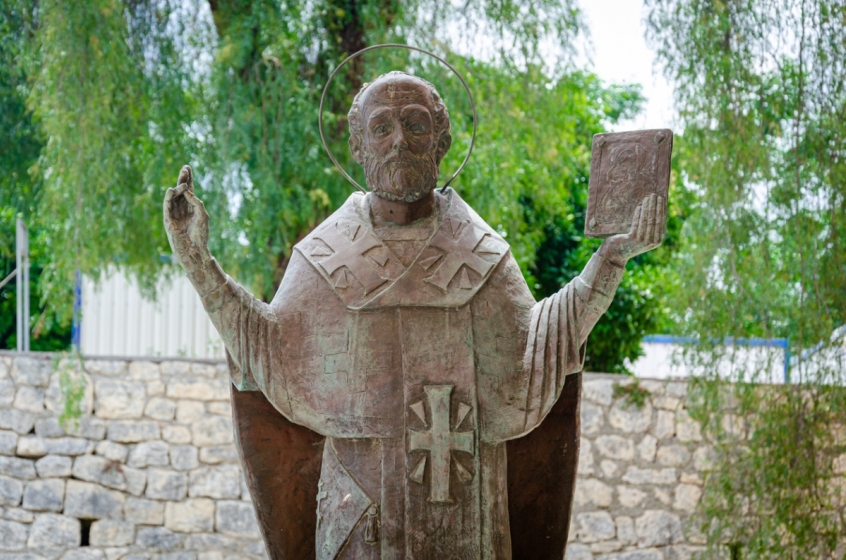
(CP) Archeologists have found the tomb that holds the remains of Saint Nicholas underneath an ancient church in Turkey. Nicholas, who became the basis for the Christmas character Santa Claus, died more than 1,600 years ago.
"This is an extremely important discovery, the first find from that period," Fox News quoted Osman Eravsar, chairman of the Antalya Cultural Heritage Preservation Regional Board, as saying about the discovery in a church in the Demre town in southern Turkey.
After rising sea levels in the Mediterranean submerged the church, a second church was built there centuries later.
"Now we have reached the remains of the first church and the floor on which Saint Nicholas stepped," Eravsar said, according to The Daily Mail. "The tiling of the floor of the first church, on which Saint Nicholas walked, has been unearthed."
Researchers have been examining the foundations of the Church of St. Nicholas in Demre for decades. They also recently uncovered a fresco of Jesus at the site.
"When the screed floor slab laid in the 1970s was removed where it was, an excavation was carried out to find out what's under it," Eravsar explained. "The result was an early fourth century floor covering of the church."
In 2017, when archeologists found the tomb but couldn't confirm, The Daily Sabah newspaper noted that the finding was considered surprising, as "the remains of St. Nicholas were believed to have been smuggled to the Italian city of Bari by Italian merchants in the year 1087."
"The Santa Claus Museum, formerly an ancient church with a sarcophagus attributed to the Christmas saint is located in the town of Demre," added the news site.
A fourth century bishop who lived under the Roman Empire, St. Nicholas was persecuted for his faith under Emperor Diocletian but lived to see Constantine come to power and legalize Christianity.
"After his release, Nicholas attended the Council of Nicaea in AD 325. He died Dec. 6, AD 343 in Myra and was buried in his cathedral church, where a unique relic, called manna, formed in his grave," notes the St. Nicholas Center.
"This liquid substance, said to have healing powers, fostered the growth of devotion to Nicholas. The anniversary of his death became a day of celebration, St. Nicholas Day, Dec. 6 (Dec. 19 on the Julian Calendar)."
Many stories have emerged about Nicholas' generosity, with these tales eventually helping to form the mythology of the modern Santa Claus.
According to History, St. Nicholas was introduced into American popular culture toward the end of the 18th century when groups of Dutch families gathered to honor the anniversary of his death.
"The name Santa Claus evolved from Nick's Dutch nickname, Sinter Klaas, a shortened form of Sint Nikolaas (Dutch for Saint Nicholas)."