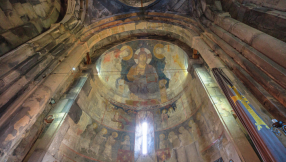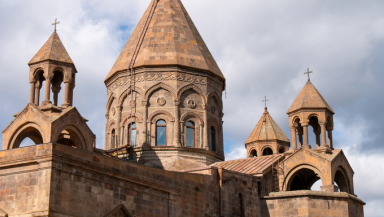
The Armenian government has charged the leader of the Armenian Apostolic Church with obstructing the enforcement of a judicial act and has forbidden him from leaving the country.
The Church has been at loggerheads with the government of Prime Minister Nikol Pashinyan since he came to power in 2018, but relations soured significantly following Armenia’s defeat in the 2020 Nagorno-Karabakh war.
The government has accused senior church leaders of supporting the violent overthrow of a democratically elected government and of condoning calls for the assassination of government ministers. Numerous Church leaders have been arrested.
Pashinyan has indicated that he effectively wants to nationalise the Church. He claims that he is attempting to save it from “anti-Christian” and “anti-state” activists and wishes to create a “real, pure, and state-centred Church”. Critics, however, have accused Pashinyan of behaving like a Soviet-ear dictator who brooks no dissent.
Such is the state of relations between the Church and the state, that the Church has decided to hold its next Synod in Austria to discuss “recent developments around the Church”.
The leader of the Church, Catholicos Karekin II, had been due to attend, but due to his travel ban, he will now be dialling in via Zoom.
In a separate development, Samvel Karapetyan, a high-profile supporter of the Church who is currently being held in detention, announced his intention to run against Pashinyan at the next election.
As well as being detained, Karapetyan has also had a number of his assets seized by the Armenian government, most notably Electric Networks of Armenia, which for many years had an effective monopoly on the Armenian electricity market.
In a statement Karapetyan said, “By arresting me and keeping me in detention, a tiny clique believed they could silence and isolate not only me, but the voice of Armenia, the voice of our people, the voice of our citizens - the voice of all of you.”
Legal representatives of Karapetyan accused Europe and the West of a “shameful” silence on the arrest of Christians in Armenia.
Robert Amsterdam, of the law firm Amsterdam & Partners said, “Now is the moment for the West and the Armenian people to defend the values of freedom of religion and conscience.”
The British government has said that it is “monitoring the situation”.
John Eibner, President of Christian Solidarity International (CSI), has called on the UK to do more to challenge the Armenian leadership and secure the release of imprisoned Church leaders and supporters.
He questioned why UK Foreign Secretary Yvette Cooper and other government ministers "remain tight-lipped, despite selectively posing as defenders of democracy, human rights and religious freedom in other contexts".
"As the UK faces its own mounting civilizational challenges, the sooner His Majesty's Government ceases to appease powers intent on the deconstruction of the Judeo-Christian civilization we share with Armenia, the more secure the British Isles will be," he said.
"This civilization and the religious freedom that uphold it are the strength and security of the UK no less than Armenia."