A Nigerian bishop has said that anti-Christian violence is reaching “genocidal” levels and has urged more recognition of the dangers posed by militant Islam.
Despite being around 50 per cent Christian, every year more Christians are killed for their faith in Nigeria than in any other country. The key driver is violence from militant Islamist groups like Boko Haram and the Islamic Fulani Herdsmen.
In August the International Society for Civil Liberties and Rule of Law (Intersociety), estimated that over 7,000 Christians were killed in Nigeria since the beginning of the year. Violence can be particularly bad during Christian festivals, with Bishop Wilfred Anagbe recently telling the British House of Lords that Christmas massacres had become “customary” in parts of the country.
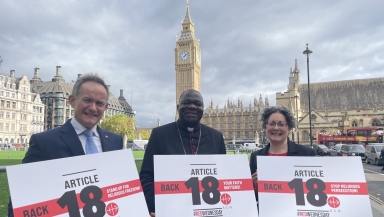
Now Bishop John Bakeni, from Maiduguri Diocese, Nigeria, has raised similar concerns with the British Parliament, stressing that religion is one of the key motivators of the violence and must not be ignored or dismissed by the international community.
“Whilst the conflict is not solely about religion, it is equally simplistic not to see the religious dimension as a significantly exacerbating factor especially as churches, priests and other potent symbols of Christianity are attacked, seemingly with impunity," he said.
“Over the past few years, violence has intensified – including horrendous massacres in the past year – in many of the attacks, the militants often first target the churches.”
Nigerian security services have often been criticised for their lack of action, even when advance warning of attacks has been given. In other cases the security forces have simply not been well equipped enough to deal with the militants.
In June, more than 270 people died when Fulani militants rampaged through Yelewata, Benue State.
Speaking of the attack, Bishop Bakeni said: “The first place they attacked was the local Catholic church, mercifully a small police patrol held them off, but instead they targeted the undefended centre of town.”
In some parts of Nigeria, the bishop said, Christian communities have been completely erased by the extremists, adding that in some areas the attacks had “assumed genocidal character” with “over 1,000 vulnerable persons” killed in one night.
In the bishop’s own Diocese of Maiduguri over 200 churches and chapels were damaged by Boko Haram by spring 2017, while in the Borno State 1.8 million people were displaced by the violence.
Many of the girls kidnapped by Boko Haram in 2014 remain in captivity, although the majority have now been accounted for.
Bishop Bakeni added, “We must be brave and have the courage of our convictions to say, whilst the causes are complex, climate change never kidnapped the Chibok girls, killed priests, or burned down churches.”