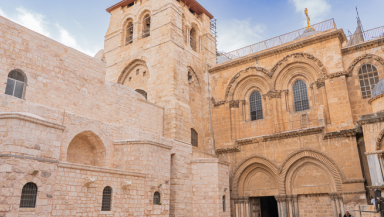
Israel's prime minister Benjamin Netanyahu has given assurances that Church leaders will now be allowed to enter the Church of the Holy Sepulchre in Jerusalem after they were blocked by Israeli police on Sunday morning.
The Latin Patriarch of Jerusalem, Cardinal Pierbattista Pizzaballa, and the Custos of the Holy Land, Fr Francesco Ielpo, were stopped from entering as they attempted to visit the church - traditionally believed to be built on the site of Jesus' crucifixion and burial - for Palm Sunday Mass, which marks the start of Holy Week.
They were prevented from doing so "for the first time in centuries", the Latin Patriarchate said.
"This incident is a grave precedent,and disregard the sensibilities of billions of people around the world who, during this week, look to Jerusalem," it said in a statement.
Israeli authorities said the police had acted out of concern for their safety amid fears that the holy site could be targeted by Iranian ballistic missiles.
The Latin Patriarchate responded to that decision by saying, "The Heads of the Churches have acted with full responsibility and, since the outset of the war, have complied with all imposed restrictions: public gatherings were cancelled, attendance was prohibited, and arrangements were made to broadcast the celebrations to hundreds of millions of faithful worldwide, who, during these days of Easter, turn their eyes to Jerusalem and to the Church of the Holy Sepulchre.
"Preventing the entry of the Cardinal and the Custos, who bear the highest ecclesiastical responsibility for the Catholic Church and the Holy Places, constitutes a manifestly unreasonable and grossly disproportionate measure.
"This hasty and fundamentally flawed decision, tainted by improper considerations, represents an extreme departure from basic principles of reasonableness, freedom of worship, and respect for the Status Quo.
"The Latin Patriarchate of Jerusalem and the Custody of the Holy Land express their profound sorrow to the Christian faithful in the Holy Land and throughout the world that prayer on one of the most sacred days of the Christian calendar has thus been prevented."
After international outcry, including criticism from US Ambassador to Israel, Mike Huckabee, Netanyahu confirmed that the Church leaders now have "full and immediate access" to the church.
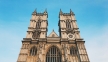
In the UK, Catholic Church leaders strongly criticised the incident, with the Archbishop of Westminster, the Most Rev Richard Moth, calling it "a clear denial of freedom of worship" and a source of "pain" for the people of the Holy Land.
Archbishop Moth, a member of the Equestrian Order of the Holy Sepulchre of Jerusalem, also called for prayers for peace and reconciliation in the wider Middle East:
“Assuring the faithful of the Holy Land of our prayerful support as we enter Holy Week, we pray ever more intently for peace across the world and particularly at this time for our brothers and sisters in the very place where the Lord’s Passion took place," he said.
“Our prayer at this time is to follow the Lord’s message to reject violence and to promote reconciliation and peace.”
His predecessor, Cardinal Vincent Nichols, Archbishop Emeritus of Westminster, called the police actions "ill-thought-out, disproportionate and unacceptable".
"As we enter Holy Week, the eyes of the world turn to Jerusalem," he said.
"Moments like this cause deep distress and scandal. Our focus should be on Jesus Christ as the Prince of Peace. Indeed, the need for peace and security has never been greater. Respect for the faith of many millions around the world would serve this cause of peace. Today we pray for the ‘peace of Jerusalem’ with renewed vigour."
Bishop Jim Curry, lead bishop for the Holy Land and religious freedom, said, “Just two months ago I was in the Church of the Holy Sepulchre celebrating Mass with Bishop Nicholas Hudson and 11 other bishops from around the world, all of whom share a care and concern for the Christians and people of the Holy Land.
"The events of today are deeply troubling. Restricting the right to freedom of worship calls into question the agreed Status Quo for the holy sites in Jerusalem and Bethlehem."