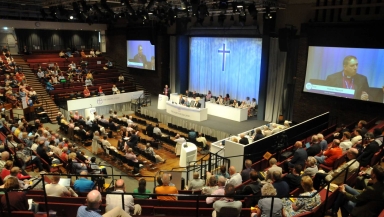
The Church of England Evangelical Council (CEEC) has welcomed “the gracious conversation and tone” of the General Synod debate when members voted that ordination candidates should no longer be required to agree to a 34-year-old document on sexuality. It nonetheless remains concerned about the current path of the Church of England.
Issues in Human Sexuality, published by the C of E’s House of Bishops in 1991, declared that clergy should either be celibate or married. It officially prevented practising homosexuals from getting ordained.
The Church of England announced after the debate on Tuesday: “General Synod backed a motion asking the House of Bishops to remove any requirements relating to the 1991 document Issues in Human Sexuality from the vocations process.
“The motion was supported by nearly all Synod members, encompassing a breadth of theological standpoints.”
The statement added: “The Private Member’s Motion, tabled by Revd Mae Christie and presented by Mr Paul Waddell (both from the Diocese of Southwark), was passed by a near-unanimous show of hands.
“This followed an amendment from the Revd Jenny Bridgman (Chester), ensuring that during the period of transition, candidates will instead be asked to adhere to the Guidelines for the Professional Conduct of the Clergy (GPCC).”
The C of E said the motion does not change the Church’s doctrine, which teaches that marriage is between a man and a woman.
“The motion does not alter the Church’s doctrine or canonical requirements, which remain in place. Rather, it reflects a desire to ensure that the discernment process for ordained ministry is both theologically robust and pastorally sensitive,” the Church said.
Progressives in the Church nonetheless see it as a positive step towards more inclusivity for LGBT individuals.
In a statement after the debate, CEEC’s national director, Rev Canon John Dunnett, raised concerns about the direction of the Church of England.
“CEEC welcomes the gracious conversation and tone that was evident in the debate around the Vocations Process and Issues of Human Sexuality during General Synod today," he said.
“CEEC is grateful for the confirmation by Jenny Bridgman (who proposed the amendment) and Bishop Mark Tanner (Chair of the Church of England's Ministry Council), that this amendment would not produce any change to the canons, doctrine, policies and declarations of the Church of England.”
But Canon Dunnett warned: “We remain concerned that Living in Love and Faith (LLF) continues on a trajectory at odds with a biblical and Anglican understanding of sex and marriage and that the interim measures agreed to by General Synod today still leave the big questions unanswered.”