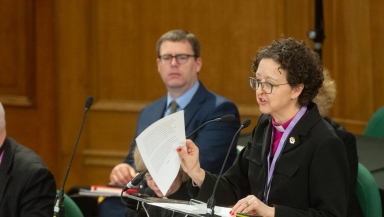
Sarah Mullally’s tenure as Archbishop of Canterbury has begun with a blitz of new measures aimed at improving the Church of England’s safeguarding practices and culture.
Her predecessor, Justin Welby, resigned due to his own failings in dealing with abuse allegations against the late John Smyth. The Church of England has also recently struggled with a scandal surrounding the founder of Soul Survivor, Mike Pilavachi, who was ordained as an Anglican priest in 2013.
A Church investigation into Pilavachi’s conduct in 2023 “concluded that he used his spiritual authority to control people and that his coercive and controlling behaviour led to inappropriate relationships, the physical wrestling of youths and massaging of young male interns".
Pilavachi subsequently resigned his position at Soul Survivor and his licence to officiate. He was also stripped of his MBE by the King.
Dame Sarah used her first address to the General Synod as Archbishop of Canterbury to lament such failures and to push for stronger safeguarding measures to ensure they are not repeated.
In response, the Synod has passed a revised Code of Practice for Bishops’ Mission Orders, a new Safer Recruitment Code, and a motion to strengthen safeguarding.
The revised Code of Practice for Bishop’s Mission Orders aims specifically to ensure that the Pilavachi scandal is not repeated.
Under the Code new worshipping communities “belong fully within the life of the Church of England and must operate within its policies and structures”. The Code also aims to foster an accountable and healthy culture of leadership.
Mike Harrison, the Bishop of Exeter, said the new rules would address “unhealthy patterns of power, personality cult and unaccountability”.
A separate Code aimed at ensuring safer recruitment practices was also passed by the Synod and is set to come into force in June.
Robert Springett, the Church’s deputy lead safeguarding bishop, said it “gives a clear message that safer recruitment is being taken seriously across the Church.”
He added, “Through my involvement in the Makin and Scolding recommendation working groups, I have learned a great deal from victims and survivors, and I hope this new Code will give confidence that work continues to make the Church a safer place for all."
The Synod also passed key safeguarding reforms, including the creation of an independent safeguarding charity.
Importantly, a new Clergy Conduct Measure was passed so that future tribunals will sit in public, except in cases where it is agreed to be “in the interests of justice” to have a closed-door hearing. The measure has to go through Parliament to reach royal assent.
The Church’s lead bishop for safeguarding, Dr Joanne Grenfell, said, "This is a significant day for the Church.
"What has been agreed is a single, unified system that brings independence and scrutiny together. This is needed to rebuild trust.
"It will deliver consistency of practice at every level of the Church - from parish to palace."