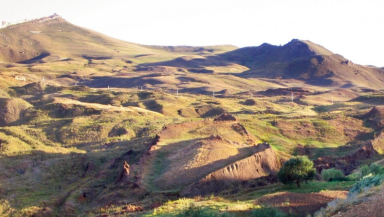
A Turkish geographer has urged caution over recent media reports suggesting that pottery fragments discovered near a boat-shaped geological formation in eastern Turkey could confirm the existence of Noah’s Ark, saying the findings are preliminary and require further scientific study.
Professor Faruk Kaya, vice rector of Ağrı İbrahim Çeçen University, said that while ceramic fragments found near the Durupinar formation may indicate ancient human activity in the area, they do not constitute archaeological proof that the site is linked to the biblical account of Noah’s Ark. Kaya, who has been involved in major archaeological and geomorphological research projects, said no conclusive evidence has yet been established to support such claims.
The issue related to latest discoveries at the Durupinar formation, a boat-shaped formation at Telçeker village of Doğubayazıt, first discovered in 1959, which some attribute to Noah’s Ark’s resting place after the flood, as recorded in the biblical book of Genesis.
GB News also amplified the claim, stating that an “archaeology discovery could PROVE Noah’s Ark existed.”
Kaya said such conclusions go beyond the available evidence. “In the studies carried out so far, no satisfactory information or evidence has been reached,” he said.
Christian Daily International approached Professor Faruk Kaya, Vice Rector of Ağrı İbrahim Çeçen University and a geographer who has taken a lead in major archaeological projects, after a wave of media reports suggested that ceramic fragments discovered near the site “could prove the biblical boat really did exist,” as quoted in the Daily Mail.
The New York Post quoted an earlier article in the Daily Mail, and the Metro carried the headline “After thousands of years, archaeologists think we’ve finally found ‘Noah’s Ark.” GB News also amplified the claim, writing stating that an “archaeology discovery could PROVE Noah's Ark existed after incredible finding.”
Kaya referenced the direct information previously shared with media sources as a result of the study: “Based on the ceramic fragments observed in the sections opened during road construction works near the geomorphological formation resembling Noah’s Ark, it is considered that there may have been human activity in the region starting from the Chalcolithic Period (approximately 5500–3000 BC).”
Based on these findings, researchers interpreted the evidence to suggest there may have been human activity in this area during a period close to the time when Noah is believed to have lived, Kaya said.
“Numerous studies have previously been carried out, and are still ongoing today, regarding where Noah’s Ark may have come to rest,” he added.
Kaya said some studies have suggested the possibility of a ship-like structure at the site but have also stressed that significantly more research is required, noting that no concrete archaeological evidence has yet been found.
“The ship-shaped formation in Telçeker village of Doğubayazıt attracts great interest because of its proximity to Mount Ararat. However, in order to identify it as the Ark of Noah mentioned in the Bible, information and documentation obtained through scientific and archaeological data are required. I can state that, in the studies carried out so far, no satisfactory information or evidence has been reached,” Kaya said.