Archaeologists in Turkey have discovered a 3rd century mural depicting Jesus as the good shepherd.
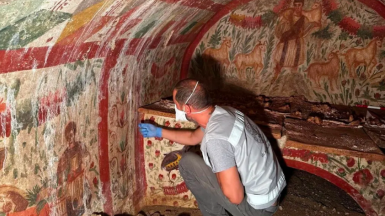
The mural, which remains in relatively good condition, is the centrepiece of a number of frescoes in an underground tomb in the Hisardere necropolis near the town of Iznik.
While Iznik may not be a familiar name to many, its ancient name of Nicaea may be better known to Christians.
In 325 AD it was the site of the First Council of Nicaea, a pivotal event in early Christianity when Constantine, the first Christian Roman Emperor, invited church leaders from all over the known world to resolve key issues of doctrine.
The result was the Nicene Creed, the basic declaration of Christian belief that all major denominations, Catholic, Protestant and Orthodox, are built upon.
The newly discovered Iznik mural depicts Jesus as a young man in a simple tunic carrying a sheep on his shoulders. He is carrying a date palm, a symbol of eternal life and resurrection.
Other images depicted on the frescoes are a deceased aristocratic couple on a funerary platform and a symposium with servants. No crosses are shown as early Christians were often cautious in the imagery they used due to persecution.
While the discovery of the mural occurred in August of last year, it was not made public until November, shortly after Pope Leo XIV visited Iznik.
The Pope was in the town to commemorate the 1,700th anniversary of the Council of Nicaea. During his trip to Turkey he was reportedly presented with a tile reproduction of the fresco by Turkish President Recep Tayyip Erdoğan.
Archaeologists are hoping that the discovery will provide greater insight into the lives of early Christians and plans are afoot to begin restoration work on the ancient artwork.