Russian authorities have continued to raid religious worship services in parts of eastern Ukraine, warning congregations that unregistered churches could face repeated disruption unless they comply with Russian law.
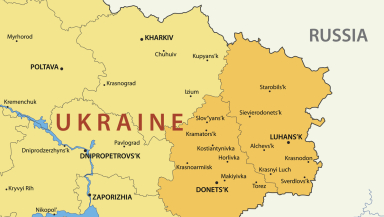
On January 25, Russian police and military authorities carried out coordinated raids on Sunday worship services run by two Council of Churches Baptist congregations in Krasnodon town (known in Ukraine as Sorokyne) in the occupied Luhansk region of Ukraine.
Some of the officers were equipped with automatic firearms, according to church leaders.
Pastor Vladimir Rytikov said officers entered the prayer hall during worship, ordered the men present to stand, and recorded the identities of several attendees, Forum 18 reports.
He was later taken to a police station and questioned about the church’s refusal to register under Russian law.
“They said that if we don't register, they'll come to every service and stop it taking place,” Pastor Rytikov said.
A second Baptist congregation in a nearby village, Teple, was raided at the same time by officers from the police unit tasked with countering extremism.
The January raids are part of a broader pattern of enforcement actions against religious communities in Russian-occupied areas of Ukraine.
Between July and December 2025, there were at least seven raids on worship meetings across Russian occupied parts of the Donetsk and Luhansk regions. Most involved Council of Churches Baptist congregations, which operate without state registration as a matter of principle, Forum 18 reports.
Five religious leaders were fined following these raids under Russia’s “anti-missionary” legislation, which penalises religious activity conducted without official authorisation.
Russian occupying authorities insist that all religious communities must register under Russian law or formally notify the authorities of their existence. Leaders are also required to hold Russian citizenship. Communities that refuse — or that retain links to Ukrainian religious structures — are treated as operating illegally.
Council of Churches Baptists have long declined registration in any country wherever they function. Russian officials, however, claim that unregistered meetings constitute unlawful missionary activity.
Russian courts have repeatedly upheld fines against pastors in occupied Ukraine on this basis, even where services were held in private homes or long-established prayer houses.
The United Nations has repeatedly criticised restrictions on religious freedom in Russian-occupied Ukrainian territory and called on Russian authorities to allow religious communities to practise their faith freely.
In a report to the UN Human Rights Council, Secretary-General António Guterres stated: “No individual should be criminally charged or detained simply for practising their religion, including in the forms of collective worship and proselytising, in accordance with international human rights law.
“Religious groups in the temporarily occupied territories of Ukraine should enjoy access to their places of worship and be able to gather freely for prayer and other religious practices."
Rights groups say enforcement actions against churches and other religious communities form part of a wider campaign of pressure in occupied territories, including the closure or seizure of churches and other places of worships, the replacement of religious leaders with figures deemed loyal to Moscow, and the detention or removal of clergy who refuse to comply.
Former detainees and human rights investigators say some religious leaders have been subjected to severe abuse while in custody, including beatings, prolonged isolation, and other forms of physical and psychological mistreatment.
The Center for European Policy Analysis (CEPA) reports that in several cases, priests and pastors have disappeared for weeks or months after being taken for interrogation, while others have been forced to flee or accept removal from their posts.
Observers say religious leaders are often targeted not for specific offences but because of what they represent.
"In the occupied territories, churches are among the few remaining institutions that command moral authority independent of the state," said Mitzi Perdue and Nicole Monette of CEPA.
International bodies warn that these measures — alongside “anti-missionary” prosecutions, censorship of religious literature, and disinformation campaigns — amount to a systematic effort to suppress independent religious life and enforce political loyalty.
Calling for "targeted sanctions" against perpetrators, Perdue and Monette, continued, "What is happening to the clergy in occupied Ukraine is more than another tragic byproduct of war.
"It is a deliberate governance strategy, removing independent moral authority and replacing it with Moscow-loyal figures. Compliance is enforced through terror."
As of early 2026, hundreds of religious communities in occupied regions have registered under Russian law, while others remain unable or unwilling to do so.
Communities linked to Ukrainian church structures, including many Protestant, Catholic and Orthodox groups, are among those most frequently targeted.
Local believers say the result is a climate of uncertainty in which worship continues under the constant threat of inspection, fines or closure.
Russian officials contacted by journalists have declined to explain the legal or security rationale for involving multiple state agencies — including police, prosecutors and security services — in raids on worship services.