The writer of the Letter to the Hebrews reminds Christians that they are surrounded by a great “cloud of witnesses.” (NRSVA) That “cloud” has continued to grow in size since then. In this monthly column we will be thinking about some of the people and events, over the past 2000 years, that have helped make up this “cloud.” People and events that have helped build the community of the Christian church as it exists today.
“First they came for the communists, and I did not speak out - because I was not a
communist; then they came for the trade unionists, and I did not speak out - because
I was not a trade unionist; then they came for the Jews, and I did not speak out –
because I was not a Jew; then they came for me - and there was no one left to speak out.”
In this way, Pastor Martin Niemöller (1892–1984) looked back on his experience of the Third Reich. Niemöller served in the German navy during the First World War and eventually rose to be the commander of the submarine U-67. In this position he won the coveted Iron Cross First Class and, at the end of the war, resigned his commission since he refused to serve under the republican government of Weimar. After studying theology, he was ordained in 1924 and became a pastor in the Protestant Lutheran Church. As a keen nationalist, Niemöller had been a member of the Freikorps (Free Corps) units – nationalists groups formed to battle communists and fight on disputed borders – even while he was studying theology. By 1931, he had become the pastor of a large church in a well-to-do suburb of Berlin.
Along with many other Germans, he looked back with nostalgia to the Germany of the kaiser, opposed the Weimar Republic, and was sympathetic to the rising Nazi movement. Revealingly, when Niemöller met Hitler, in 1932, he was consoled by a promise that there would be no antisemitic pogroms or ghettos in Germany; only legal restrictions would be put in place regarding the Jews. That the promise of restrictions caused him few concerns at this time reveals how deeply ingrained antisemitic prejudices were in many Germans.
As an anti-Communist, Niemöller hoped that the Nazis, under Hitler, would promote German unity, traditional values, and a national Christian revival. Vast numbers of German Christians felt the same way, as did millions more who supported far-right movements across Europe in the 1930s. However, for Niemöller, his support rapidly turned to disillusionment …
The influence of German history on Christian outlook
Nazism was, in its nature, utterly incompatible with New Testament Christianity. In addition to core-beliefs in love and forgiveness – which the Nazis found weak – was the obvious Jewish heritage of Christianity. Rooted in the Old Testament and in Judaism, the Church put its faith in a Jewish Messiah, Jesus, and revered the gospels and letters written by the Jewish followers of Christ. Furthermore, it holds that faith in Christ transcends all barriers of ethnicity and class; ideas which are utterly alien to the racist nationalist ideology of the Nazis.
Given this, why were so many German Christians supportive of the Nazis in their rise to power and why were so few involved in active opposition once the realities of the Third Reich became apparent?
The answers are complex but can perhaps be reduced to three key factors: the particular history of the German churches; the medieval legacy of antagonism towards Judaism; and the European context of the 1920s and 1930s.
One of the features of the German churches was a close alliance between Church and state. This had emerged out of the German Reformation of the 16th century and had been strengthened in the Prussian takeover of Germany in the late 19th century. As a result, German Protestantism lacked political radicalism and its support for government had become entrenched. This was, of course, not a situation unique to Germany. But it did leave the Church there peculiarly open to being influenced by Prussian-style nationalism, German-centredness and an unwillingness to challenge the state.
For Catholics, fairly recent history had been different but had also played a part in forming attitudes which impacted on strategies in the 1930s. From 1871 to 1877 the Catholic Church in the newly formed German Empire (united under Prussian leadership in 1871) had found itself engaged in the so-called ‘Kulturkampf’ (culture struggle) with the government, under Chancellor Bismarck.
This involved an unlikely coalition of the government, liberals, and conservatives pursuing a series of policies which included: a desire to see Protestantism dominant in Germany (popular amongst Prussian conservatives), efforts to ensure that intellectual life was free from Catholic clerical influence (popular amongst liberals), and the establishment of a German community which was free from the external influence of the Pope (popular among members of the Prussian-dominated government).
While this conflict had calmed down by the 1880s, it left a legacy which would influence the 1930s. As a result, the Catholic Church in the 1930s was both keen to avoid conflict, yet almost inevitably on a collision course with the Third Reich whatever concessions it offered.
Regarding the Jewish community, the German churches suffered from the racism that had infiltrated much of the intellectual thought-life of Europe from the Middle Ages onwards. Furthermore, this dark heritage of scapegoating Jews for social problems and in treating them as ‘alien others’ (no matter the reality of their integration into German society) meant that Jews were not regarded by many European Christians as a closely related religious group. Antisemitic statements by Martin Luther added to this outlook.
Finally, the perceived threat from Communism, in the period after 1917, led many Church members to fear it (and secularism) more than any other political ideology. Given the persecution of Christians in the newly formed USSR and the blatantly atheistic ideology of the Soviet government, it seemed that the main threat to Christianity came from this direction, rather than from Nazism and the far-right generally. This assessment was encouraged by the way in which the Nazis (who in reality had no adherence to Christian principles whatsoever) referred to themselves as defending Christian civilisation and to the Führer being sent by God.
For those Church members eager to overlook the unpleasant features of Nazism, these words gave them assurances that the Nazis would not threaten Christianity. Some Church members went even further and genuinely believed that the ‘revival’ in German national life promised by the Nazis would include Christian values and the safeguarding of the life of the Church.
Conflict
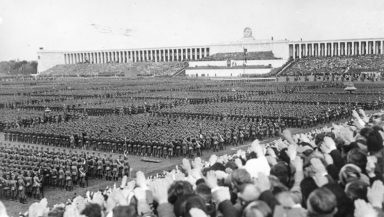
The German Protestant community – numbering 40 million and making up two thirds of the German population – had provided a great many of those who had voted Nazi in the years leading to Hitler’s appointment as chancellor in 1933.
In the early days of Nazi rule the new government harnessed support by actions which seemed to signal its alliance with this section of the population. The 450th anniversary of Martin Luther’s birthday in 1933 was accompanied by massive celebrations. In addition, the new regime sought to reassure Protestants and the old Prussian traditionalists by the so-called ‘Day of Potsdam’ in March 1933. The Protestant service took place in the Church of Saint Nicholas and a Catholic Mass took place in the parish church. It was choreographed to reassure.
But already cracks were beginning to appear in this facade. Hitler and Goebbels, both nominally Catholic, did not attend the Mass because Catholic bishops were still maintaining a ban on Nazi Party membership.
Within the Protestant churches though, things looked more hopeful for the Nazis. Since 1932 a group of Nazi sympathisers amongst the clergy – calling themselves the ‘German Christians’ – sought to bring the Church into line with Nazi ideology. In the early summer of 1933 this led to the establishment of a ‘Reich Church’ to replace the regional churches which had made up the old Evangelical Church of the old-Prussian Union (as the German Protestant Church was called).
Supported by Hitler, and given massive propaganda support by Goebbels, its leader as Reich Bishop was Ludwig Müller, a Nazi. Under his leadership crude antisemitic strategies were imposed on the Protestant Church. While he had achieved his dominant position through behind the scenes politicking and threats, there was an alarming level of support for this Nazification of the Church from those living on the borders of the Reich (where ethnic tensions over disputed frontiers were high) and among some pastors.
Pastors, who were members of the ‘German Christians’ were known to preach in brown SA and black SS uniforms. Some called for the abandonment of the Jewish Old Testament and the writings of ‘the Rabbi Paul’. There was talk of substituting the swastika for the Cross and Jesus was spoken of as an ‘Aryan hero’ and his Jewish origins ignored.
By September 1933 opposition to these activities was growing. In that month Niemöller and Dietrich Bonhoeffer led a group which set up the ‘Pastors’ Emergency League’, as a rallying point for those clergy who opposed the racially-motivated ideas of the ‘German Christians’. Unlike the latter, the former group which would, from 1934, be called the ‘Confessing Church’ drew a greater proportion of its membership from better educated pastors and it had a much larger number of women in its ranks. The Confessing Church refused to expel Jewish converts and insisted that its basis for faith lay solely in the Bible, which the Nazis had attempted to edit, attack and undermine.
By the end of 1934 the Nazi hopes of creating one unified – and Nazified – Reich Church were in ruins. Müller, who had failed in this attempt to bring the Protestant Church into line, eventually committed suicide in July 1945 in the wreckage of the Third Reich that he had helped to build.
University theology departments soon mirrored the splits within the Church. At the University of Bonn, the leading theologian, Karl Barth, was a supporter of the Confessing Church and was opposed by the dean, who was a ‘German Christian’. Soon over two thirds of the lecturers had been dismissed or transferred. At Munich University the Nazi authorities closed the theology faculty entirely.
In the face of this opposition the Nazi authorities cracked down on dissent. Pastors who criticised the regime were banned from preaching or had their pay stopped. Others were arrested and, by 1937, some 700 were in prison, including Niemöller. In prison he finally rejected his earlier antisemitic opinions. Frequently beaten by his guards he would remain in prison until the end of the Second World War.
The Protestant Church he left behind remained divided. A minority continued to back the discredited Reich Church with its enthusiastic Nazis; a minority supported the increasingly beleaguered Confessing Church; but most German believers kept silent. All too often Church leaders were led by German public opinion rather than leading it. In the late 1930s Bishop Meiser, head of the Bavarian Protestant Church, still offered public prayers thanking God for Hitler.
The 20 million Germans in the Catholic Church found that they, too, were under increasing pressure in the 1930s. The Nazis faced this Church with particular ambiguity. On one hand they opposed its allegiance to an internationally organised community which looked outside Germany for leadership; on the other hand they admired its organisation, influence and discipline. Several leading Nazis came from a Catholic background. These included Hitler, Goebbels and Heydrich the head of the SS Security Service (the SD). All had become determinedly anti-Christian.
The Nazis particularly resented the fact that – unlike the Protestants – German Catholics had actively opposed the Nazis in their rise to power. The Catholic community had solidly voted for the Centre Party (until its dissolution in 1933 under Nazi pressure), had sat through sermons condemning the Nazis, and in many areas had been openly told that no Catholic could join the Nazi Party. But once the Nazi Party was in power, what would be the stance of the Catholic Church?
To start with, it made concessions which were clearly intended to defend the integrity of the Catholic Church by surrendering certain areas of activity. So, in 1933, the Centre Party was wound-up and Catholic trade unions were dissolved. In July 1933, Pope Pius XI concluded a Concordat with the Nazi state. In return for the Catholic Church’s agreement to keep out of political activity, the Nazi government agreed to respect the various Catholic organisations in Germany. Like every other institution which sought to reach an understanding with Hitler, the leadership of the Catholic Church soon discovered the worthlessness of these assurances.
Even before the summer of 1933 was over, Catholic newspapers were being shut down and the activities of Catholic organisations were being restricted. Although alarmed, the Church hierarchy did not protest, in the hope that statements of obedience would serve to deflect the Nazis from these attacks. It was a vain hope. There were, though, public criticisms voiced of the regime’s persecution of ‘non-Aryan’ Catholics. However – as with many in the Protestant community – this did not extend to a defence of Jews unless they had converted to Christianity. During 1934, increasing pressure was put on Catholic young people to join the Hitler Youth and violent attacks were mounted on young Catholics by Hitler Youth members.
By 1935, Clemens von Galen, Bishop of Münster and a Cardinal defended the rights of Catholic schools to carry out religious instruction. Galen was too high profile to arrest and he was to continue his protests against Nazi activities. In 1941 he condemned the euthanasia of ‘Aktion T4’ targeting people with disabilities and the mentally ill, forced sterilisation, Gestapo terror, and the concentration camps. He also protested at the closure of Catholic churches and monasteries. He survived because the Nazi leadership considered that arresting him would have a seriously negative effect on support for the regime in Catholic areas. Action was postponed until the end of the war. But Galen outlived the Third Reich and eventually died in 1946. Yet Galen never publicly condemned the deportation and murder of the Jews.
In March 1937 the Papal Encyclical - entitled "With burning sorrow" – was read in Catholic churches, condemning the Nazi breaking of the Concordat. Despite this protest, about 33 per cent of Catholic priests experienced some form of state harassment by 1945 and, by 1939, all Catholic Church schools had been either taken over by the state or shut.
However, with the outbreak of war, the Nazi campaign against Christianity became muted with the need to promote national unity. And most German Christians loyally supported the war effort to the bitter end. Few – at any level – protested at the persecution and then the destruction of the Jews. The latter was an open secret since vast numbers of soldiers serving on the Eastern Front knew about the mass killings from 1941 onwards and referred to it in letters home and when on leave.
An example of another way
The struggle with one religious group, though, did not end with the start of the war in 1939. Although not part of the historic Christian Church in Germany and with profound doctrinal differences which distanced it from orthodox Christianity, Jehovah’s Witnesses suffered a level of persecution out of proportion to their size. By 1945 somewhere in the region of 10,000 (of the total membership in Germany of about 30,000) had been imprisoned and 950 died in the concentration camps. It was a level of peaceful resistance to Nazi demands for loyalty and cooperation that the mainstream German churches never came remotely near matching.
Some, though, signposted that a path of non-compromise was possible, but deeply costly. From 1937, until his liberation by US forces in April 1945, Niemöller was imprisoned: first at Sachsenhausen, then at Dachau concentration camps. Others in the Confessing Church did not survive the war. In April 1945 (shortly before Niemöller was liberated) Bonhoeffer was hanged at Flossenbürg concentration camp.
In Niemöller’s suffering, and in Bonhoeffer’s martyrdom, a small minority in the German churches had gone some way towards making atonement for the wider Church’s failure to comprehensively confront Nazi nationalism for what it was: the enemy of Christian beliefs and values.
As nationalism, and racial and ethnic tensions, are once more on the rise in 21st-century Europe, the alliance between millions of Christians and the Nazis, and the far-right generally across the European continent in the 1930s and ‘40s, stands as a stark warning.
Martyn Whittock is a historian and a Licensed Lay Minister in the Church of England. The author, or co-author, of fifty-eight books, his work covers a wide range of historical and theological themes. In addition, as a commentator and columnist, he has written for several print and online news platforms and is frequently interviewed on TV and radio news and discussion programmes exploring the interaction of faith and politics. He has a particular interest in the ‘deep stories,’ with which we frame the present by reference to the past. Recent books that explore such ‘deep stories’ include: American Vikings. How the Norse Sailed into the Lands and Imaginations of America (2023) and Vikings in the East. From Vladimir the Great to Vladimir Putin - The Origin of a Contested Legacy in Russia and Ukraine (2025).