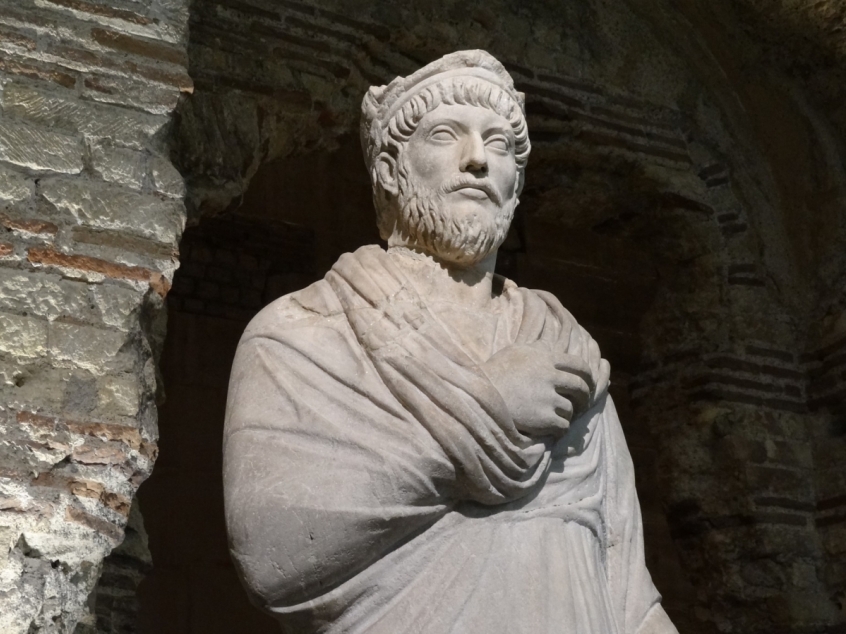
Today marks the death of the Roman emperor Julian, remembered in Christian tradition as 'Julian the Apostate' – a pagan famed for his hatred of Christianity. It's said his dying words were addressed to Christ: 'You have conquered!'
Flavius Claudius Julianus, born around AD 331, grew up amidst a kind of Christian heritage. He was raised by his older son Constantius as a Christian – and Constantius' father (Julian's uncle) was Constantine, the very first Christian emperor, famed for conquering in the name of Christ.
It's said that Julian kept up the act of a Christian, but in his heart he was a pagan – awed by the classical philosophers. And, as the historian J Stephen Lang observed, Julian couldn't see much good in Christianity – his supposedly devout uncle had murdered his own wife and one of his sons, forever marring Julian's vision of the faith.
When Constantius died, Julian became the emperor and went public with his paganism. He also made clear his opposition to Christians – the 'Galileans' as he called them. But unlike his predecessor Nero, Julian didn't have them thrown to the Lions, since he recognised that martyrdom and persecution often seemed to only strengthen the Church.
He sought a subtler way to undermine the Church: he removed the land and financial privileges that clergy and Christians had previously enjoyed, and set out to restore Rome's Hellenistic, polytheistic heritage by rebuilding pagan temples. He later removed Christian educators who didn't believe in pagan legends, and tradition tells of how he executed his two Christian bodyguards when they opposed his policies.
Constantine had showed him a rather bloody vision of Christianity, but looking at wider society, Julian was impressed by the love and generosity of Christians, noting their charity extended not just to their own, but to pagans. Julian attempted to create his own pagan cult, that imitated Christian generosity, but had limited success.
Julian's ambitious rule lasted only two years, he was killed age 32 in battle with the Neo-Persian empire, in AD 363. It's said that on his death – by the stabbing of a spear – Julian's last words were 'You have conquered, O pale Galilean'.
Referring to Jesus Christ, it's a dramatic line which nicely captures Julian's wrestling with Christianity – although it's probable he didn't actually say it.
It would have felt true to many though: Some Christians reportedly saw his death – the fall of empire's last pagan emperor – as God's judgement on Roman paganism.