In many European countries, December 31, also known as New Year’s Eve, is better known as St Sylvester’s Day or simply Sylvester, named after a pope from the time of the Council of Nicaea. This is the story …
New Year’s Eve
Around the world New Year’s Eve is marked by parties and fireworks at midnight. However, what is called New Year’s Eve in the English-speaking world is better known as Sylvester by people from across many European countries, especially those of largely Catholic heritage. For German, Slovak and Slovenian speakers the day is called Silvester, for Hungarian speakers it is called Szilverster, for Czechs it is Silvestr, for Poles it is Sylwester, for Croats it is Silvestrovo. For French speakers it is the feast of la Saint-Sylvestre, and for Italians it is San Silvestro. But who was Sylvester?
Sylvester
Not a lot is known about Sylvester’s early life. Dates for his birth range from AD 250 to 285 in Rome or near Naples, and his parents were said to be called Rufinus and Justa. The sources do agree that he was from Italy and became a Benedictine abbot and priest, before being elected to succeed Miltiades as bishop of Rome (known as the Pope) in AD 314. This was a pivotal time because in 312 Emperor Constantine became a Christian and in 313, the Edict of Milan ended state persecution and granted the church legal standing and privileges in the Roman Empire.
Pope Sylvester
Sylvester was then Pope for 21 years from 314 until he died. He is significant mainly because his long pontificate coincided with Christianity’s transition from a persecuted religion, to being the official imperial religion. The Council of Arles happened during his first year in 314 and condemned the heresy of Donatism. It was during the papacy of Pope Sylvester, that the Nicene Creed was formulated in AD 325, which had its 1,700th anniversary in 2025. Pope Sylvester did not attend the council, but he was represented by legates and he accepted its decisions.
Legends
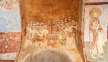
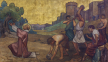
Two legends arose from the story of Sylvester and Constantine. One was that Constantine was healed of leprosy when Sylvester baptised him, which echoes the story of Naaman in the Jordan (2 Kings 5:10). Today there is a small pilgrimage church called “Santuario di San Silvestro Papa” in Monte San Silvestro area of Sant'Angelo a Scala near Naples, which is by a spring whose healing waters are said to have healed Emperor Constantine. The other legend was that Emperor Constantine granted temporal authority over Rome and the West to the Pope, which was a legend which later popes quoted to justify their power. Whatever the truth of these, and even modern Catholic historians reject them, Sylvester got on well with Emperor Constatine, and was the first Pope to govern with the help of imperial support and resources, and so is seen as the first institutional Pope.
Churches in Rome
Under Sylvester, Constantine sponsored the building of some major churches in Rome significantly: Basilica di Santa Croce in Gerusalemme (Basilica of the Holy Cross in Jerusalem); San Giovanni in Laterano (St John Lateran), which is the Pope’s official cathedral; and Basilica di San Pietro (St Peter’s Basilica), which was replaced in the sixteenth century by the current St Peter’s at the Vatican.
Death
Sylvester died in Rome on December 31, 335. He was originally buried in the catacomb of Priscilla on the Via Salaria, but in 762 his remains were moved to a church dedicated to him called San Silvestro in Capite, on Piazza San Silvestro in Rome. San Silvestro (St Sylvester) holds masses in English and traditionally serves British and Irish Catholics in Rome. St Sylvester is regarded as a patron saint of stonemasons because of the great building projects which took place when he was Pope. Sylvester was never formally canonised but after his death he was known as St Sylvester. Sylvester was one of the first holy men who was not a martyr to be honoured as a saint. As commonly happened with saints his day of remembrance was the anniversary of his death, hence December 31, which became the Feast of St Sylvester or St Sylvester’s Day, or just Sylvester.
Order of St Sylvester
St Sylvester is the patron saint of a papal order of chivalry called the “Militia Aurata”, or “Golden Spur”, which according to legend was founded by Emperor Constantine. In 1841, Pope Gregory XVI, created the Order of Pope St Sylvester. Since 1905, Pope St Pius X created four classes: Knight/Dame, Knight/Dame Commander, Knight/Dame Commander with Star (Grand Officer), Knight/Dame Grand Cross.
St Sylvester’s Day
St Sylvester’s Day came synonymous with New Year’s Eve in the Catholic tradition. Later after there were two other Popes by the name of Sylvester in the tenth and eleventh centuries, he became known as Pope Sylvester I.In 1582 when Pope Gregorian XIII reformed the calendar, January 1 became the official New Year’s Day across much of Catholic Europe, instead of Lady Day, which made December 31 the definitive last day of the year. Therefore, the association of St Sylvester’s day with New Year’s Eve dates back to this time. For example, Polish people around the world will often gather for a “bal sylwestrowy” (Sylvester Ball).
Meanwhile in Protestant Europe the marking of saints’ days and remembering popes was mainly discontinued, and St Sylvester became forgotten. In Scotland celebrating New Year became Hogmanay.
Dinner for One
In Germany and Scandinavia there is a tradition to watch an English comedy sketch called “Dinner for One”. This British comedy sketch by Freddie Frinton and May Warden dates from 1963 and is loved in German-speaking countries and across Scandinavia where it is shown each year as part of traditional viewing for Sylvester, with its catchphrase “Same procedure as every year”.
Reflection
As we reflect on the 1,700th anniversary of the Council of Nicaea we can remember Pope Sylvester who endorsed the Nicene Creed and took the opportunities for the Church, afforded by Emperor Constantine’s conversion. Across much of central Europe New Year’s Eve is simply known as Sylvester in his honour.