The King Charles III England Coast Path was officially launched last week as one of the most ambitious walking routes in the country. When complete, the trail is intended to give people far greater access to England’s coastline, linking beaches, estuaries, cliffs, harbours and nature reserves through one continuous national route.
It has been created not only to open up more of England's coast to walkers, but also to secure lasting public access in places where older routes have been limited or vulnerable to erosion. In that sense, it is both a walking trail and a long-term investment in the shared life of the coast.
The path offers something more for Christians, too, because along England’s shoreline stand chapels, abbeys and priory ruins that tell the story of prayer, mission and witness across many centuries.
Here are five remarkable Christian stops worth visiting, each rooted not only in its own history but also in the wider coastal landscape around it.
St Michael’s Mount, Cornwall: a chapel above Mounts Bay
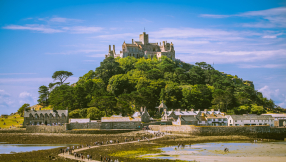
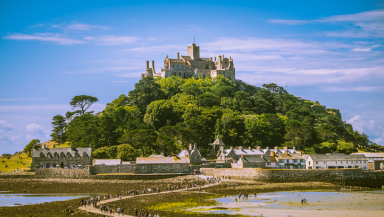
One of the most memorable places on the South Cornwall section of the coast path is St Michael’s Mount, the tidal island that rises from Mounts Bay near Penzance. This stretch of the trail, running from Penzance eastwards towards Cremyll, is one of the best-loved parts of the route, taking in broad sandy beaches, fishing villages, wooded creeks and dramatic headlands.
Between Penzance and St Mawes, walkers pass the wide sweep of Mounts Bay and continue through a coastline shaped by both beauty and variety. There are the beaches at Praa Sands, and further east the route moves towards Falmouth, the Helford estuary and the striking landscapes of the Lizard, the most southerly peninsula in the country, known for its rare plants and important coastal habitats.
Beyond St Mawes, the trail continues through estuary country around Fowey, Looe and the Tamar, with notable viewpoints including Nare Head, Dodman Point, Gribbin Head and Rame Head.
In the midst of this rich Cornish setting stands the church of St Michael’s Mount. It began as the church of a priory in the 12th century, built for Bernard of Le Bec, an abbot linked to Mont Saint-Michel in France. That connection is a reminder that medieval Cornwall, for all its distance from centres of power, was still part of a wider Christian world.
After serious earthquake damage in the late 13th century, much of the church was rebuilt in the early 14th. Later, when foreign-linked religious houses were dissolved, the priory came to an end. In time the building served as a parish church and now functions as a chapel. It was restored in the 19th century by the St Aubyn family, whose long ownership of the Mount became part of its later story.
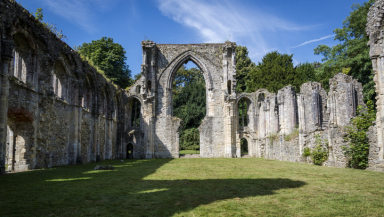
Netley Abbey: monastic ruins by Southampton Water
Netley Abbey is near Southampton Water and remains one of the finest surviving Cistercian abbey ruins in southern England. Perhaps easily overlooked in comparison to some of the more dramatic cliff-top sites along the coast path, it nonetheless sits within a region full of maritime history, charming estuary landscapes, and reminders of England’s long relationship with the sea.
The abbey itself was founded in 1238 under the influence of Peter des Roches, Bishop of Winchester. Although he died before building began, the project continued, and monks from Beaulieu Abbey came to establish the new community. Once completed, Netley was home to monks, lay brothers and those who supported the life of the monastery. Like other Cistercian houses, it would have balanced worship, labour and a well-ordered community life.
That monastic chapter ended in 1536 during the Dissolution under Henry VIII. The site was then given to Sir William Paulet of Winchester, who transformed the former abbey into a Tudor mansion. Parts of the monastic complex were adapted for domestic use, showing how many religious houses entered entirely new lives after the Reformation.
Later, after the mansion was abandoned, Netley became famous as a romantic ruin. Its setting above Southampton Water, surrounded by trees and looking out towards the busy maritime world beyond, drew artists and writers who found beauty in its decay. By the 1840s it had also become a popular place for local people to gather for tea, dancing and music, although some felt that kind of entertainment spoiled its atmosphere. In time, attitudes changed again, and the site was cleared of overgrowth and debris, while later Tudor features were removed so that the abbey could be seen more clearly in its medieval form.
Netley belongs to the broader southern coastal sections of the King Charles III England Coast Path include historic ports, ferry crossings and shorelines marked by both natural beauty and military history. Nearby stretches in South Devon, for example, feature places such as the Royal William Yard, Mount Batten Tower, Fort Bovisand, Dartmouth Castle and the long bar of Slapton Sands, forever linked with preparations for the Normandy landings in 1944. Further east, the Dorset coast includes Chesil Beach, Portland and Lulworth Cove.
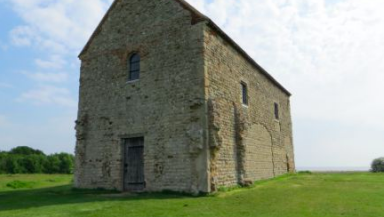
St Peter-on-the-Wall, Essex: faith on the marshes
Few places on the coastal path feel as ancient and exposed as the Chapel of St Peter-on-the-Wall at Bradwell-on-Sea. Set on the Essex coast amid marshland, sea walls and open estuary views, it stands in a landscape that can seem almost stripped back to nature's essentials: sky, water, wind and stone.
The Essex, Thurrock and Southend stretches of the coast path are shaped by tidal rivers, low-lying marshes, old fortifications and places where national history meets everyday coastal life. Walkers along this part of the route will encounter views of Tilbury docks and the London Gateway port, old defensive sites such as Tilbury Fort and Coalhouse Fort, and landmarks like Hadleigh Castle. There are also more modern points of memory, such as the place where the Empire Windrush docked.
It is a coastline of estuaries and sea walls rather than towering cliffs, but it has a depth of character all its own.
St Peter-on-the-Wall reaches back much further. It is associated with St Cedd, who came south from Lindisfarne in the 7th century to preach among the East Saxons. Arriving at the remains of an abandoned Roman fort, he used the stone already on the site to create a more lasting place of worship. That makes the chapel one of the most important early Christian sites in the country, joining together Roman, Anglo-Saxon and missionary history in one place.
In the centuries that followed, the chapel passed through neglect and recovery. By the 15th century it had been reported as damaged and unusable, though it was later repaired and returned to worship for a time. Eventually it fell out of regular church use and was even adapted as a barn.
Its strategic coastal position gave it another role during the Napoleonic wars between 1803 to 1815, when it became part of a signalling network as a semaphore station used for relaying urgent messages along the coast. In the 20th century it was handed over to Chelmsford Cathedral, restored and reconsecrated, and it has since become a place of pilgrimage once more.
The chapel stands as a witness to a form of Christian faith that was hardy, missionary and enduring, planted at the edge of the land and still standing there today.
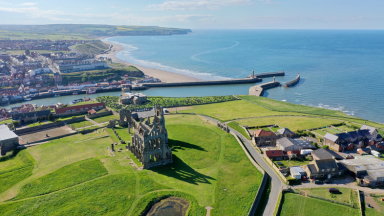
Whitby Abbey: a headland shaped by prayer and decision
Standing high above the North Sea, Whitby Abbey is one of the great Christian landmarks on the entire coast path. It stands on the East Cliff above Whitby, where the dramatic geography of the North Yorkshire coast gives the ruins a commanding presence over the harbour and town below.
The wider section of the coast path that it sits within takes walkers through Middlesbrough, Redcar and the North Yorkshire coast.
The route is a striking one, making its way from the industrial edge of Teesside through seaside towns such as Redcar and Saltburn, then on towards Whitby, Scarborough and Filey.
Along the way are cliff paths, fishing villages, broad beaches and quieter stretches where seabirds may be your main company. The route also links with the Cleveland Way National Trail and benefits from the coast path’s “rollback” protection, which helps keep access open even as erosion continues to reshape this fragile coastline.
Whitby sits naturally within this setting of sea views, steep headlands and old maritime communities. The abbey’s story began in AD 657, when King Oswiu of Northumbria granted land for a monastery founded under Abbess Hilda. It became one of the leading religious centres in Anglo-Saxon England.
Its most famous moment came in 664, when Whitby hosted the Synod of Whitby, a meeting that helped determine whether the English church would follow Roman or Celtic practice in matters including the date of Easter. The outcome was decisive for the future shape of Christianity in England.
The early monastery was later abandoned after Danish Viking raids during the 9th century, but a new Benedictine community was established on the site after the Norman Conquest in the late 11th century. The great Gothic ruins that dominate the headland today belong mainly to that later abbey, which was dissolved in the 16th century. Even after its religious life ended, the site remained a landmark for sailors and a source of artistic inspiration for writers and painters such as Bram Stoker, the author of Dracula.
Whitby Abbey is remembered as the place where the English church once made a defining choice, and where the sea has continued to frame that legacy ever since.
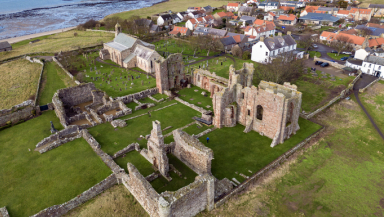
Holy Island of Lindisfarne: pilgrimage at the edge of the sea
There are few places on the English coast where Christian history feels as alive as it does on Holy Island. Lindisfarne lies off the Northumberland coast and is reached by a tidal causeway, meaning that twice a day the sea cuts it off from the mainland. That rhythm of access and separation has shaped the island’s identity for centuries.
The Northumberland coast is one of the most remarkable sections of the King Charles III England Coast Path. From Seaton Sluice to Berwick-upon-Tweed, the route runs through wide sandy beaches, rolling dunes, mudflats, wildlife-rich shores and historic coastal villages. It is also famous for its castles - the most famous being the stunning Bamburgh - and other ruins.
Lindisfarne became one of the great centres of early Christianity in Anglo-Saxon England. Once home to St Oswald and closely linked with St Cuthbert and with the missionary life of the early Northumbrian church, it remains a place of pilgrimage today for those drawn by its deep spiritual heritage. The priory ruins seen today belong to a later medieval phase, but the island’s Christian importance reaches back much earlier, to a community of faith, learning and prayer whose influence spread far beyond the island itself.
The site also carries the memory of Viking attack, a reminder that coastal monasteries were both spiritually important and physically vulnerable. Over time, Lindisfarne became not only a centre of worship but also a symbol of the endurance of faith in a place exposed to danger and change.
Nearby Lindisfarne Castle tells another side of the island’s story, linked less to monastic life and more to defence. Yet even with those later military layers, Holy Island remains above all a place of pilgrimage. It is the final destination of St Cuthbert’s Way and still draws visitors seeking quiet, prayer and perspective.
The natural setting only deepens that experience. The surrounding national nature reserve includes mudflats, dunes and salt marshes, with wildfowl, wading birds and seals all part of the life of the island. The crossing itself feels almost symbolic: a journey out of ordinary time and into a place set apart.
Final thoughts: More than a national trail
The King Charles III England Coast Path is a major access project, but it is also something richer: a long invitation to encounter the landscapes and stories that have shaped England. For Christians, that includes places where the faith was preached, practised, tested and renewed.
Dear reader, if you’re one of those walking the newly opened sections, you’re not just partaking in a leisure stroll with fine views and fresh air, but also a journey through a living map of memory, where abbeys, chapels and priory ruins still bear witness to the God who has been worshipped on these shores for generations.
From the tidal heights of St Michael’s Mount to the early mission chapel at Bradwell, from the ruined splendour of Netley and Whitby to the pilgrim paths of Lindisfarne, these sites reveal a coastline marked not only by natural beauty but by centuries of devotion.