At Christmas time we read about King Herod who ruled Judea at the time of Jesus’s birth, and he is the villain of many Nativity plays. But King Herod was a real historical character. This is the story …
End of the Davidic Dynasty
In the Old Testament the Kingdom of Israel the stories of the kings and queens of Israel and Judah are told in the first and second book of Kings. The last king of Judah descended from King David was King Zedekiah, originally named Mattaniah (2 Kings 24:17--25:7), when Jeremiah was the prophet. After this Jerusalem was destroyed and the Babylonian exile began.
Hasmonean Dynasty
After the return from exile the Jewish kingdom was not restored, and the territory came under Greek control. In 139 BC the Hasmonean family, known as the Maccabees, defeated the Seleucid Greeks, and they became the kings of Judea. They were Jews, not from the tribe of Judah, but were a priestly family from the tribe of Levi. They were popular because they reinstated Jewish independence and they were Jewish. They conquered the territory of Idumea (Edom) and the Idumeans adopted the Jewish religion and became Jews. The stories of the Maccabees are told in the first and second book of Maccabees. In 67 BC Alexandra Salome, the reigning Queen of Judea, died and there was a civil war of succession between her sons.
Roman Rule
In the context of the civil war, the Roman General Pompey attacked Jerusalem and annexed Judea, which ended the independent Jewish state. In 47 BC an Idumean (Edomite) leader called Antiper was appointed as procurator of Judea, whose job was to collect taxes for the Romans. In about 72 BC, Antiper had a son Herod who later became friends with the Roman leader Mark Antony, who made him Governor of Galilee, where Herod earned a reputation for cruelty. Antiper was assassinated in 43 BC and Mark Antony made Herod tetrarch of Galilee.
When the Parthians attacked Jerusalem, Herod went to Rome for help and he was appointed king of the Jews by the Senate should he reconquer it. He returned and with Roman help overthrew the Parthians and from 37 BC ruled as a Roman client king for over thirty years. Much of what we know about King Herod comes from a Jewish historian called Josephus who wrote a history of the Jewish people.
King Herod
Herod was unpopular with the Jews because he was seen as a usurper and hated for his collaboration with the Romans. To endear himself to the Jews, Herod married Princess Mariam (often spelt Mariamne) from the Hasmonean dynasty, and appointed his wife’s brother Aristobulus, who most Jews regarded as the true heir to the throne, as High Priest.
Herod had ambitious plans for Judea. Herod helped to develop the region and built amphitheatres, aqueducts, and fortresses such as Masada, which was all paid for by heavy taxation. Perhaps trying to make himself a great king like Solomon, in 20 BC he doubled the size of the Temple Mount and adorned the Temple in Jerusalem with gold and marble making it a marvel. Judea had no natural harbour so he founded Caesarea Maritima in 9 BC, a great port which allowed Judea to trade with the Mediterranean world, with freshwater supplied by an aqueduct. Herod built himself palaces at Jericho and Herodium near Jerusalem.
However as his reign went on, he got crueller and became a paranoid tyrant who eliminated any perceived rival to his throne, including surviving members of the Hasmonean dynasty, and even members of his own family. Caesar Augustus remarked, “I would rather be Herod’s pig than his son.”
King Herod and Jesus
We first read about King Herod in the Bible at the start of Matthew and Luke. Luke gives a passing reference to Herod the Great when he writes that the birth of John the Baptist was “during the time when Herod was king of Judea” (Luke 1:5).
Then Matthew writes “Jesus was born in the town of Bethlehem in Judea, during the time when Herod was king” (Matthew 2:1). The reason that Joseph and Mary went to Bethlehem was a Roman registration or census (Luke 2:1-3) which King Herod, as a client king of the Romans, was administering.It was maybe about a year after this that King Herod met the visiting wise men (Matthew 2:1-12) and was concerned about a new king being born. The text says, “When Herod the king had heard these things, he was troubled, and all Jerusalem with him” (Matthew 2:3).
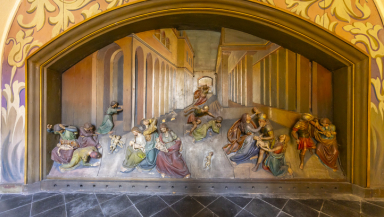
It was hardly surprising that all of Jerusalem was troubled because people feared the reprisals of a potential rival. Herod became so worried about the prophesied Messiah that he ordered the slaughter of all the infants who were under two years of age around Bethlehem (Matthew 2:16). In the context of knowing how Herod killed all perceived rivals, this massacre is in character and fits our knowledge of the historical Herod.
Having killed any potential claimants from the Hasmonean dynasty, it makes sense that he would want to kill any potential claimants from the Davidic dynasty. Therefore, Joseph took Mary and Jesus and fled into exile to Egypt, where they were beyond the reach of Herod, until his reign ended when he died (Matthew 2:19).
Herod’s Death
Herod died in Jericho in about 4 BC, or 1 BC, depending which scholarship you prefer. He was buried at his palace fortress at Herodium. After Herod’s death, Caesar Augustus divided Herod’s kingdom between three of his sons. His son Archelaus governed Judea, Samaria, and Idumea (Edom) as ethnarch, while his son Herod Antipas was tetrarch of the provinces of Galilee and Perea, and his son Philip became tetrarch of territories of Iturea and Trachonitis to the north and east of Galilee.
King Archelaus
After they had heard that Herod had died, Joseph and Mary would have hoped that it was safe to return to Judea from their exile in Egypt. Joseph must have waited for news about the new king Archelaus before deciding. Weeks after becoming king, Archelaus put down unrest, and Josephus says he killed 3,000 people and cancelled Passover. It is hardly surprising then that we read that “when Joseph heard that Archelaus had succeeded his father Herod as king of Judea, he was afraid to go there” (Matthew 2:22). Archelaus was considered as cruel as, or even crueller than his father, but he only ruled Judea and Samaria.
Herod Antipas
Joseph therefore took Mary and Jesus (and any other children they might have had in Egypt) and went to live in the province of Galilee at Nazareth. Nazareth was where they lived before, and was ruled by Herod Antipas, who was not feared like Archelaus was, although later Antipas would behead John the Baptist, and question Jesus and send him to Pilate before his crucifixion.
Legacy
After his death Herod became known as Herod I or Herod the Great, to help distinguish him from the other Herods of the Herodian dynasty who followed him. His descendants of the Herodian dynasty ruled the region for a few generations after him. In AD 70 the Romans destroyed much of Jerusalem including the Temple, but the Western Wall of Herod’s Temple Mount survives and is a holy site for Jews today. In AD 73 Herod’s fortress of Masada became the last stand for Jewish rebels and today is a major tourist site. In 2007 Herod’s tomb was discovered by archaeologists at Herodium. These days however, King Herod is best known as the villain in Nativity plays.